




'Everything is Finance’ and 5 More Takeaways From Otelier Optimize 2026


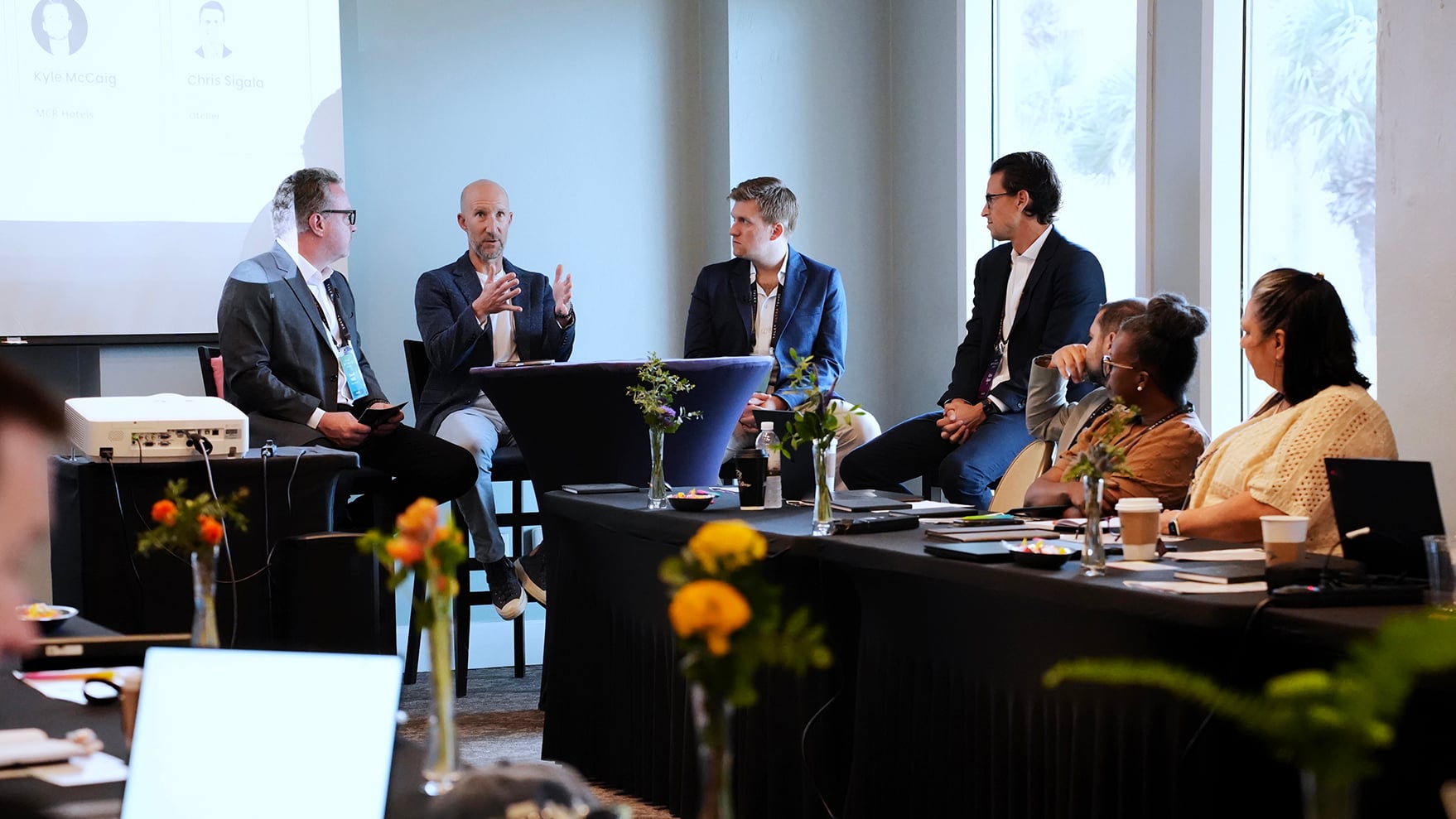
Put 25 people who run hotels for a living in one room, ask good questions, and get out of the way.
That was the idea behind Otelier Optimize 2026. Last week, we brought 25 of our top customers together at Hammock Beach Golf Resort & Spa to compare notes on running more efficient hotels, where the industry is headed and how technology will support it, and how our solutions could be better. I came to listen and learn, and it was a privilege to sit at that table.
Learning new things is energizing. Learning alongside hoteliers who are solving real problems is even better. Across two days, the conversation kept returning to one question: How do we equip hotel teams to make better decisions as their businesses get more complex and we build toward the future of hotel operations?
Here are the six takeaways that stuck with me and what they mean for your hotels in 2027.
1. Profit Needs a New Operating Model
Nobody in the room expects 2027 to be easy. Operators described slowing group pace for Q1, tough leisure comparisons and a K-shaped market where luxury holds rate and extended stay can’t. Real GOPPAR is still down 20% from 2019, and costs, technology included, are climbing faster than revenue.
“The uncomfortable truth is that we have to operate our businesses differently. The model that we used 10 years ago, the model we use today, is not the model of the future,” said Dana Cariss, Senior VP of Revenue Optimization at CoralTree.
In a year like this, top-line growth won’t define success. Flow-through will. That means scrutinizing how work gets done and holding every technology investment to one test: What operating outcome will this improve, and how will we measure it? This includes knowing the true cost of every booking.
2. Everything Is Finance
“Everybody thinks this is finance, that is finance. Everything is finance,” said Rob Smith, CFO at Crescent Hotels & Resorts.
Most hotel companies still aren’t organized that way. Every decision on property becomes a number at month-end, often after an exhausted night auditor served as the last line of defense. And a day that balances isn’t necessarily a day that’s right.
“Sure, the day balanced, the income journal looks great, but this normally doesn’t go to this GL account,” Shawn Goodwin, VP of Revenue and Distribution at Highgate, gave as an example.
The smartest finance teams are moving upstream – they publish who owns each data handoff and turn month-end cleanup into daily early warning.
3. Dashboards Are Dying
For years, hotel business intelligence solutions sold visibility – more reports, more charts, more logins. But a chart leaves the hardest part, interpretation, to someone who doesn’t have time for it. Hoteliers need early warnings – overtime about to hit, an expense running off pattern – with enough context to act.
“We don’t have dashboards anymore. We have command consoles or operational consoles,” said Todd Wood, VP of Technology at Mandarin Oriental Hotel Group.
CoralTree Hospitality is already building it, with AI agents reviewing every P&L in its portfolio and flagging gaps faster than any analyst could.
The next era of hotel tech will be judged not on what it shows but on what it recommends – and whether people act on it.
4. Budget Every Day, on Your Own Data
The best operators treat outside forecasts as context, not gospel, and build from their own trends. They’ve also stopped treating the budget as a once-a-year ritual; in a market moving this fast, it’s stale by spring.
“A lot of these external predictions are about as accurate as exit polls are these days,” said Kyle McCaig, VP of Technology operations at MCR Hotels.
If daily reforecasting feels like a leap, start weekly. More frequent forecasts let teams adjust staffing, spending and strategy sooner.
5. AI Should Redesign Work – With Guardrails
Labor is still the biggest line on the P&L. But hotels already ran lean after COVID, and the room rejected the idea that AI simply means fewer people.
“Where I’ve seen opportunity is AI helping with labor optimization, not necessarily AI taking people,” Wood said.
The caveat: Verify everything, because AI raises the stakes on data quality. A seasoned controller notices when a number looks off; an agent may act on it with total confidence. As I told the room, context is everything.
Don't start with a headcount target. Pick a few defined tasks that your team hates, make sure the data behind them is trusted, name who reviews the output, and expand only as the results hold up.
6. The Guest Is Still the Point
Cutting admin work should free teams to lead, solve problems and take care of guests. Technology should stay behind the scenes; even a platform built to simplify fails if the team sees it as one more login.
“It’s still a people business,” said McLean Xavier, CIO at InnVest. “These are tools you use to enhance people’s ability to be more personable.”
Where We Go From Here
Hoteliers aren’t asking for more technology. They’re asking for less friction: fewer screens, better answers and numbers they don’t have to second-guess.
That’s a high bar for every tech provider, ours included, and we left Hammock Beach with homework of our own. I’m grateful to every customer who spent two days teaching us. The work ahead is turning those conversations into better decisions for the people running hotels – and better stays for the people sleeping in them.
For more takeaways from Otelier Optimize 2026, subscribe to our weekly newsletter, Otelier Outlook.

