.svg "Group (2)")




Hunter Conference 2026: ‘It Is What It Is’


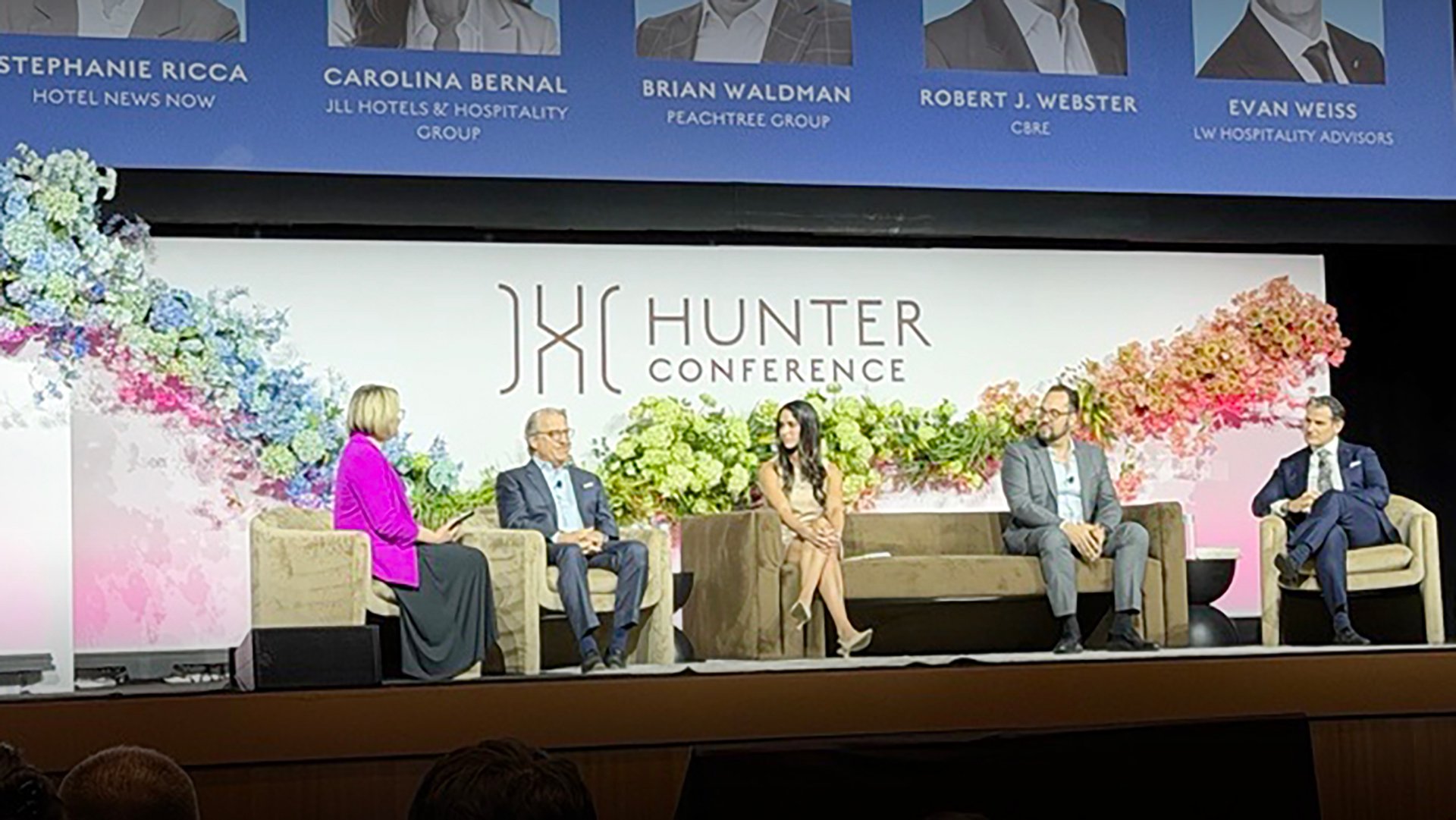
Despite a war in Iran and softening demand predictions for the upcoming FIFA World Cup, hotel leaders at the Hunter Conference in Atlanta said it’s business as usual – owners, operators, and developers are navigating uncertainty with a focus on performance and practicality.
“It's almost like the industry and travelers have just said, ‘Hey, it is what it is. We've got a business to run, or I've got a vacation I need to take,’” said STR’s Isaac Collazo in a podcast recorded with colleague Jan Freitag on the conference floor.
Collazo’s word of choice to describe the current landscape was “sanguine” – not overly optimistic, but grounded in improving data and a sense that the industry is learning to move forward.
“We’ve had two better months than we thought,” Collazo said, pointing to stronger-than-expected performance early in 2026. “The sea is changing a little bit… the clouds are breaking, the sun is coming out.”
But Freitag offered a counterbalance, highlighting several risk factors still looming – geopolitical instability, rising fuel costs, and inflation pressures that could limit discretionary travel spending.
After spending decades at a nearby hotel, Hunter Conference moved this year to a beautiful new conference center hotel in Atlanta, the Signia by Hilton – staff and amenities were fantastic – and it appears as if Hunter Conference has taken the next step in becoming one of the top conferences for the hotel investment community to gather. The conference grew to about 2,000 attendees this year.
Financial Markets Overview
The annual “transaction overview” panel made one thing clear: capital is starting to move again.
After a prolonged period of hesitation, panelists said that hotel transactions began picking up in Q4 of last year – driven in large part by major institutional players re-entering the market.
“When those houses start making moves, now it’s our turn to do it,” said Brian Waldman of Peachtree Group.
Large moves by firms like Blackstone and Brookfield helped restore confidence across the market, creating a ripple effect that encouraged smaller investors to re-engage. Two segments stood out: leisure-driven markets in Florida and luxury resort destinations.
Panelists also emphasized the role of psychology in driving deal activity.
“We’re an industry that has serious FOMO,” said Robert Webster of CBRE. He pointed to San Francisco as a recent example: once avoided by investors, it quickly became a target market again after a single high-profile acquisition.
At the same time, panelists said that macroeconomic conditions – particularly interest rates – will continue to play a critical role. Lower rates could unlock additional transaction volume and improve valuations.
“I feel like we’re at the start of a new cycle,” Waldman said.
Webster said the current environment is a “phenomenal buying opportunity” for long-term investors, while also cautioning attendees to prepare for continued volatility: “Get ready for a rocky ride and understand you don’t know what’s happening next.”
Hilton CEO Chris Nassetta on AI
One of the most anticipated sessions at the conference featured Chris Nassetta, President and CEO of Hilton, who offered a clear and practical perspective on how AI is beginning to reshape hotel operations.
Rather than focusing on hype, Nassetta outlined three tangible ways AI is already influencing the business:
1. Smarter, data-driven capital allocation
AI is enabling more precise decisions around capital expenditures. Instead of relying on rigid timelines, operators can use data to determine when assets actually need to be refreshed.
2. A shifting distribution landscape
He pointed to emerging platforms like OpenAI and Gemini as potential new intermediaries in hotel distribution. Increased competition, he said, ultimately benefits operators by driving efficiency and lowering costs.
3. Enhanced guest experiences through “phygital” innovation
Nassetta described the future of hospitality as a blend of physical and digital experiences – what he called “phygital.” AI will play a central role in delivering more personalized, seamless guest interactions while improving operational efficiency.
His broader message was one of confidence in the industry itself.
“It’s a great industry that provides opportunities to grow in your career,” he said, pointing to improving investment activity, easing interest rates, and continued consumer demand for experiences.
On the Ground: What Hoteliers Are Saying About Data and AI
Beyond the main stage, Otelier gained some valuable insights from conversations with operators on the show floor (see video above). Across roles and disciplines, one theme came through clearly: the fundamentals still matter.
Operators consistently pointed to core performance metrics – occupancy, ADR, RevPAR, GOP, and NOI – as the foundation of their decision-making. At the same time, there’s growing emphasis on more operational and guest-centric data, including satisfaction scores, restaurant performance metrics, and labor efficiency indicators.
But while there’s no shortage of data, accessibility remains a major challenge.
“I think we have pretty much everything we want,” said Brian Gilchrist of Good Hospitality. “What I struggle with is trying to get it all in one place… to get to that real-time P&L.”
When it comes to AI, the tone was notably measured.
Some operators expressed skepticism, particularly around accuracy and the time required to validate outputs. Others see long-term potential but acknowledge that adoption is still in its early stages.
“There’s a lot of noise,” said Patrick O’Neil of Visions Hospitality Group. “But where we do see it coming is… alleviating time from our general managers and operations leaders.”
Together, these perspectives reinforce a key takeaway from the conference: while AI is a major focus, the real opportunity right now lies in getting the data foundation right. Centralization, accuracy, and accessibility remain the critical building blocks for everything that comes next.

