.svg "Group (2)")




Goodbye K-Shape, Hello ‘Strong Industry Fundamentals’


What a difference six months makes.
Late last year and into this year, conversations about the hotel industry were dominated by caution. Consumer sentiment was shaky, RevPAR declines were cascading, and lower-income travelers were pulling back, creating a K-shaped performance environment in which luxury hotels continued to thrive while select-service properties struggled to keep pace.
That certainly wasn’t the vibe last week at the Hotel Data Conference in Nashville.
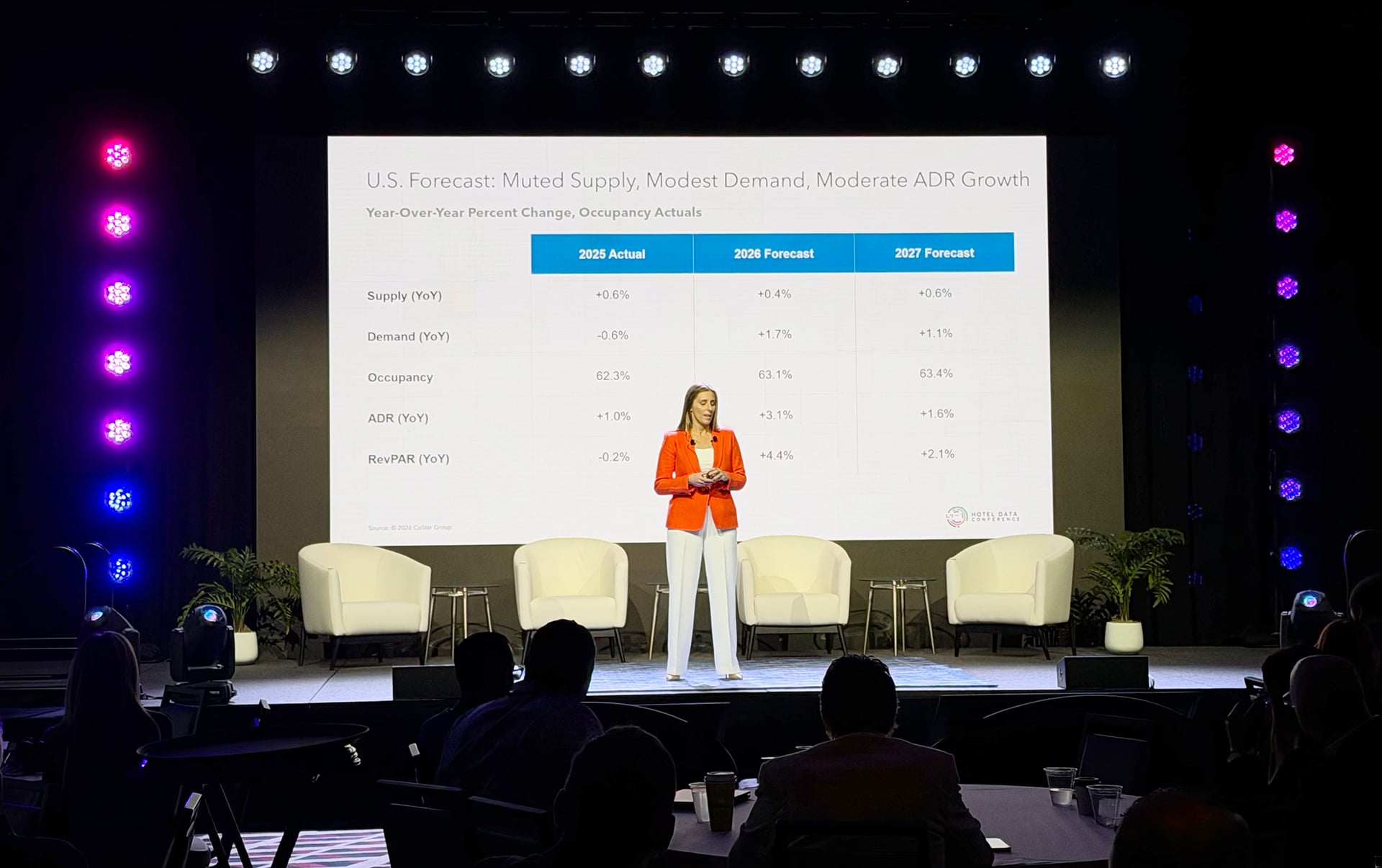
“The fundamentals are strong,” Amanda Hite, president of STR, told attendees during the opening general session, while announcing a revised forecast calling for 4.4% RevPAR growth for the remainder of 2026 and 2.1% growth in 2027.
The outlook has undergone something close to a 180-degree turn, and the conversation has shifted from protecting against downside risk to figuring out how hoteliers can capitalize on stronger-than-expected performance.
Growth Spreading Across the Industry
Perhaps the most encouraging development: We may finally be saying goodbye to the K-shaped recovery.
Earlier this year, the top of the market was doing much of the heavy lifting. Affluent consumers continued to travel and luxury hotels performed well, while pressure on lower-income households weighed disproportionately on economy and select-service properties.
That gap is beginning to close.
“We are beginning to see a curl at the bottom of the K,” Tourism Economics President Adam Sacks said.
In other words, recovery is broadening. Hite said STR is seeing gains across chain scales, driven in part by ADR growth that has been stronger than expected. ADR is now forecast to finish the year up 3.1%.
The World Cup certainly helped. June and July produced significant rate gains in host markets, even if the event didn’t quite deliver the equivalent of the “104 Super Bowls” that FIFA President Gianni Infantino once promised.
But one of the most important messages from the opening session was that the improving outlook extends well beyond the World Cup. Corporate and group demand remain strong, supply growth nationally is below 1%, and momentum is showing up across markets and segments.
And travelers are finding new reasons to hit the road. Sacks pointed specifically to concerts increasingly becoming “mega events” capable of generating significant travel demand – another example of experiences continuing to win consumers’ discretionary dollars.
-1.jpeg?width=1920&height=1155&name=Image%20(4)-1.jpeg)
The Rate Debate
One thing I always find interesting about HDC is the disclaimer CoStar provides throughout each conference about avoiding conversations that could be considered collusion... and then various speakers move right into suggesting revenue managers in the room focus on driving rate.
Numbers show that this year’s recovery has been led by ADR growth over occupancy, and that trend is expected to continue into next year.
“The time is now to be focused on rate,” said Brian Berry of Pyramid Global Hospitality. “The cost of orange juice is up, the cost of hotels is up – people expect it.”
Partly due to that strong rate growth, the industry is finally beginning to see some relief on the profitability side as well.
According to Hite, hotel revenue growth has outpaced expense growth every month since March – something the industry hadn’t experienced for more than a year. STR expects Gross Operating Profit to increase approximately 4% this year.
That doesn’t mean the margin battle is over. Inflation-adjusted GOP per available room remains below 2019 levels, and labor, food and beverage and other operating expenses continue to pressure profitability.
But the crossover between revenue and expense growth may represent an important inflection point.
Comps Will Challenge 2027 Budgeting
There was one topic where nearly everyone seemed to agree: Setting budgets for 2027 isn’t going to be easy.
The World Cup created unusual performance patterns in many markets. Some hotels generated enormous ADR premiums, while others lost corporate and group business that deliberately avoided host cities. Those distorted comparisons will begin showing up next summer.
Add changing inflation, continued labor pressure and shifting demand patterns, and simply taking 2026 actuals and applying a growth percentage isn’t going to cut it.
Berry said Pyramid is placing significant emphasis on improving labor forecast accuracy and sees an opportunity for technology to play a larger role.
“We want to see AI show up in our budgeting process,” he said.
AI Conversations are Getting More Practical
If last year was about asking what AI could do for hotels, this year’s conversations felt much more focused on where it can actually create value – and what needs to happen before organizations deploy it at scale.
During a panel on AI in commercial strategy, speakers repeatedly emphasized that technology alone won’t fix fragmented systems, inconsistent standards or poorly defined processes. Organizations first need to scope the problem, map their systems and understand exactly what they’re trying to accomplish.
Arlene Ramirez said implementing AI isn’t like replacing a broken PMS. Hoteliers shouldn’t start with “We need AI” – they should start with “What problem are we trying to solve?”
There are also bigger workforce questions coming.
Sloan Dean, former Remington CEO and Host of Not Done podcast, asked: If employees are saving 10 hours per week using AI, what exactly is the plan for those 10 hours?
Eventually, he said, these efficiency gains will change how hotels think about staffing.
And as AI adoption grows, governance will become equally important. Panelists stressed establishing clear rules around what employees can upload into AI tools, protecting sensitive company and guest information, and considering closed or approved AI environments rather than giving employees unrestricted access to every available model.
.jpeg?width=1920&height=1621&name=Image%20(55).jpeg)
A Much Different Conversation
The hospitality industry certainly hasn’t run out of challenges. Inflation remains stubborn. Costs remain high. Margins remain under pressure.
But walking out of HDC, the difference from the conversations we were having at the beginning of the year was striking.
Forecasting performance across an entire global industry is hard, and STR will be the first to admit they don’t always get it right. And aggregated forecasts spanning hundreds of markets and thousands of hotels won’t always reflect what’s happening at your hotel, in your market.
But that’s what makes HDC so valuable. The data provides a baseline for measuring your own performance, while the forecasts and perspectives shared on stage offer a guide for where the industry is headed – and how you might adjust your own expectations for the remainder of 2026 and into 2027.
This year, that direction is looking considerably more optimistic than it did just six months ago.
Subscribe to Otelier Outlook for weekly updates like this, direct to your inbox.

