.svg "Group (2)")




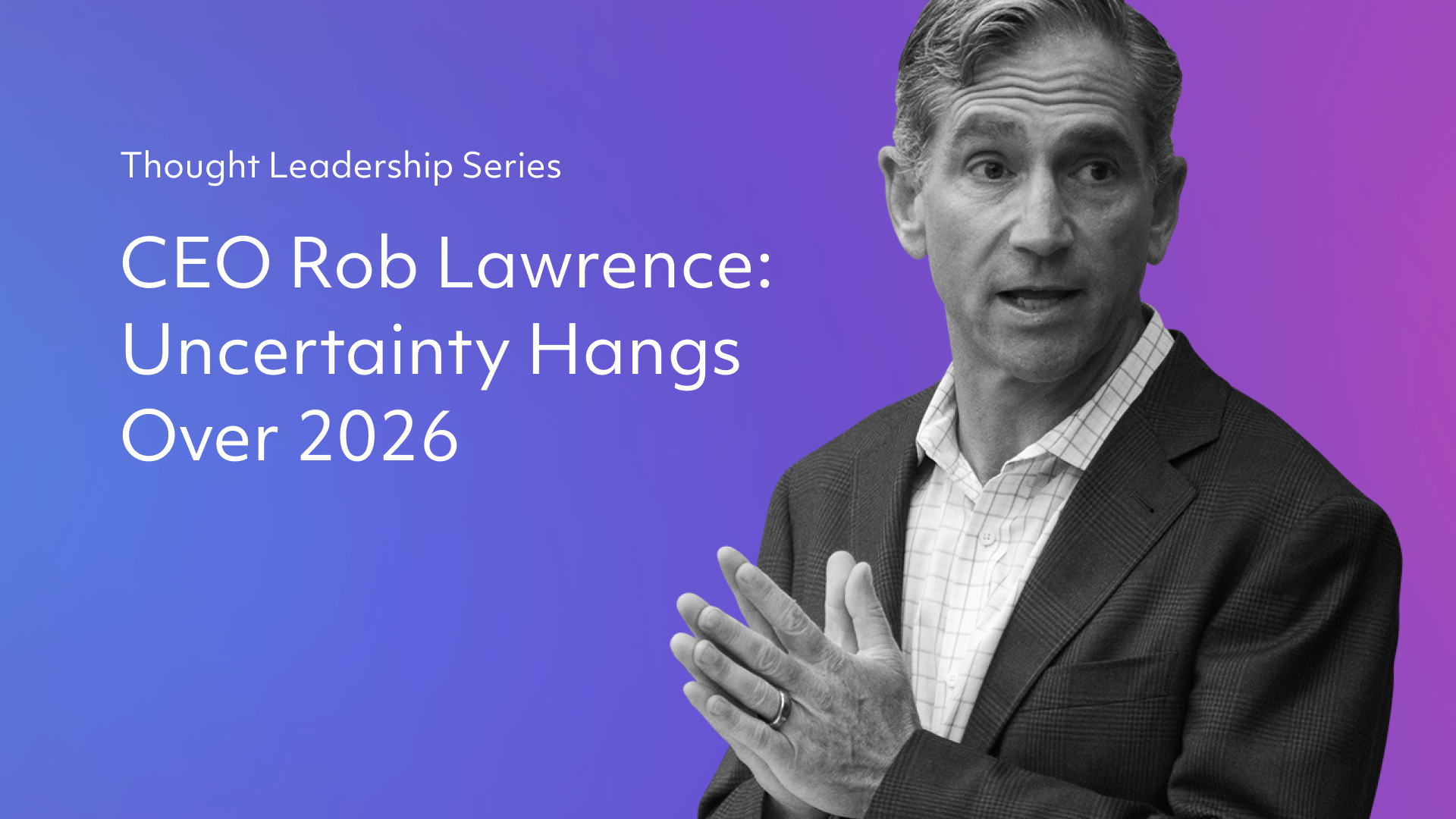
Otelier CEO Rob Lawrence: Uncertainty Hangs Over 2026


As hoteliers prepare to meet in Los Angeles and discuss the state of the industry at ALIS next week, the word I expect we’ll hear most from the stage is “uncertainty.”
- Uncertainty about travel demand and consumer spending.
- Uncertainty about labor and wage pressure.
- Uncertainty about interest rates, refinancing timelines, and the cost of capital.
And perhaps most importantly, uncertainty about what “good performance” even looks like in 2026 – because the market isn’t moving as one. We’re entering what’s being referred to as a “trifurcated” market – where luxury, midscale, and economy hotels are forecasted to perform very differently in 2026, and each will require a distinct playbook.
In luxury and upper-upscale, performance has remained more resilient – and in many cases, guest expectations are rising just as fast as costs. For leaders in this segment, the conversation is often less about chasing incremental demand and more about focusing on a delightful guest experience while ensuring margins remain healthy.
In midscale, the outlook tends to feel more like treading water. Pricing power can vary widely by market, and even small shifts in demand can impact profitability when costs remain elevated. This is where forecasting discipline can play a meaningful role, especially as business mix shifting makes it harder to rely on historical patterns.
In economy, there’s often limited room to absorb cost increases or operational inefficiencies. More teams in this segment are exploring economies of scale and process automation as ways to reduce manual workload and protect margins, particularly across accounting and commercial departments.
Efficiency Is the New Advantage
Across each of these segments, when demand feels inconsistent, operators naturally look inward.
Not necessarily to pull back, but to better understand where costs are rising, where inefficiencies exist, and where teams are spending time on work that could be streamlined. In a year like 2026, operational efficiency isn’t just an internal initiative – it can become a competitive advantage, especially for organizations managing thin margins across multiple properties.
One helpful way to approach this is by asking practical questions that can reveal where the most meaningful improvements exist:
- Where are we overstaffed or understaffed – and how do we know?
- What processes are still manual that should be automated?
- What else can we automate today to free up real hours tomorrow?
- Which properties are outperforming, and why?
This is also where technology conversations are starting to shift. Instead of viewing new tools as “innovation projects,” more teams are evaluating technology based on whether it can reduce friction, eliminate manual steps, and help leaders make decisions with greater confidence and agility.
From AI Hype to AI Readiness
As owners and operators become laser-focused on controlling costs and driving efficiencies in operations, technology and AI are primed to help.
The potential for AI to revolutionize hotel operations is real, but at the same time, many organizations are also recognizing that AI outcomes depend heavily on the quality of the inputs underneath. Without timely, accurate, standardized data, AI can struggle to deliver clear results – or may produce insights that require even more time to validate.
In a recent survey of nearly 80 hotel leaders conducted by Otelier, Agilysys and Sage – results of which will publish Monday – only 25% of hoteliers say they’re ready to adopt AI, with cost, ROI uncertainty, and data gaps cited as the top barriers.
AI readiness often starts with foundational work that may not look glamorous, but tends to have outsized impact. For many hotel organizations, it can be more helpful to think about AI as part of a broader effort to reduce manual work, improve visibility, and strengthen operational discipline.
Owners Want More Visibility
When performance is uneven across segments and markets, owners need more than topline updates. They want visibility into what’s driving results, where risk is emerging, and how forecasts are changing in real time. That’s one reason business intelligence has become increasingly important: it can provide a shared, consistent view across every management company, system, and asset.
BI can support stronger alignment between owners and operators by creating shared definitions and shared dashboards. It can reduce end-of-month surprises and make asset reviews more strategic by focusing the conversation on trends, drivers, and decisions – not just the numbers themselves.
Closing Thoughts
We can’t remove uncertainty from the market. But we can reduce uncertainty inside the business by tightening operations and using data to support smarter, faster decision-making. In many cases, that’s what helps leaders stay confident and consistent – even when the external environment is anything but.
If you’ll be at ALIS next week, I’d love to connect and compare notes. Connect with me on LinkedIn or shoot me an email to set up time in LA.

